Showing posts with label Hollywood. Show all posts

Wednesday, February 19, 2020

The Author's Life For Me...

February is #AuthorLifeMonth. I missed out on the beginning because I was away in NC, then visiting family. I'm going to do it in two blog posts, so here's 1-14:

2/1 - Meet me:
Once a newspaper reporter, until Hollywood calls, Charlotte lives in NJ with her husband, sons, two needy cats, and sometimes a deranged squirrel. Her books include the middle grade trilogy, Evolution Revolution: Simple Machines, Simple Plans, Simple Lessons. She co-authored the Sirenz series: Sirenz, Sirenz Back In Fashion, Blonde Ops, and two anthologies: Beware the Little White Rabbit and Scare Me to Sleep. Currently she’s polishing up several MG, YA and NA novels various genres.

2/2 - My Books:
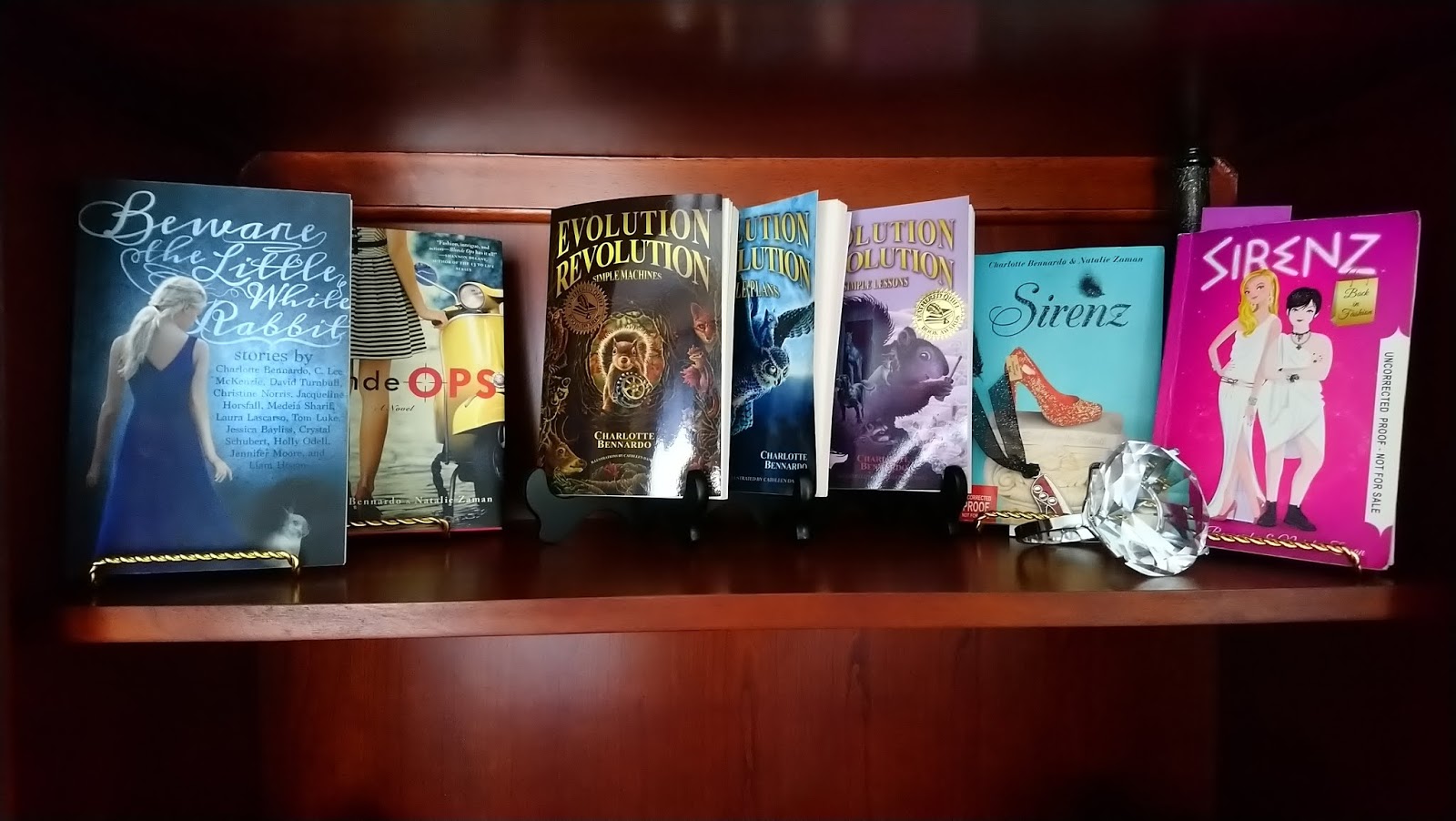
Missing is the ebook, 'Scare Me to Sleep' 

2/3 - Writing Fuel:
Chai latte in my Patriots mug! 


2/4 - Biggest Fan/Mascot:

Mink and Casey


2/5 - Show a Shelf:

My favorite library shelves!

2/6 - Inspiration:
So many things inspire me: fairy tales, horror stories, people, places, bits of conversations, weird dreams... you name it. I wish I could live long enough to write all the stories in my head...


2/7 - Swag:
Just some of the swag from my books...

2/8 - My WIP:
(First paragraph from my tween novel which involves a continuation and a twist on a horror classic...)

With an easy finger, I stroke Rogue, the 8th grade science room hamster, softly on her head. Leaning over, I let her whiskers tickle my nose before I gently place her back in her fun house cage. She burrows deep into the pine bedding and disappears. My teacher, Mr. Gogi, only lets me feed the animals. He says I have a ‘way’ with them. Maybe I understand how they feel; they’re stuck in a cage or tank while I’m stuck in middle school prison. They want to be free as much as me, but none of us  are.

2/9 - Fashion:
I don't dress 'out there' except I have a thing for funny socks...

2/10 - Bookish Bucket List:
*NYTimes Bestseller list
*multi book deal
*appear at event with several authors I admire
*have my screenplay produced into a TV/movie
*have a famous author tell me they read 1 (or more!) of my books!
*be an SCBWI keynote speaker

2/11 - Goals Accomplished:
*been pubbed several times by traditional publishers
*fans told me how much they loved my books
*signing event at Book Expo America where 300 people showed up to get a signed book
*successfully did NaNoWriMo several times
*given numerous workshops and classes on writing
*been asked to give presentations

2/12 - Other Fave Media:
Instagram! I see a different side to people aside from writing and it's a chance to make friends out of the author circle. I can 'chat' with celebrities, see places I'd like to go, and learn about things going on in different places of the world.

2/13 - Writer Friends:


Just a few of my many author friends! Wish I could fit you ALL in! 

2/14 - Treat Yourself:
Reading poolside... doesn't get much better (unless I'm in the Caribbean!)


So that's #AuthorLife in half a month. Next blog post, days 15-28.

Char 

Monday, January 13, 2020

Break Time!

Do you take a break between manuscripts? Don't you think your computer might like a little respite too?

Photo courtesy of Drew Williams, Pexels.

These are some of the things I like to do when I'm in between manuscripts:

1. Clean your screen and keyboard. If you're like me, sometimes when you get on a creative roll, you eat and drink at your desk (or in the coffee shop, or on the couch, or patio table, etc.) Eating means sticky or greasy fingers. Using lens cleaner or a dampened with water cloth (NO PAPER TOWELS- THEY CAN SCRATCH), clean both screen and keys.

2. Don't forget to clean INSIDE your computer: get rid of junk, old emails, copies of your kids' school papers, spam, anything you don't need. Then, do a defrag to clear out memory.

3. Now's the time to get anything fixed: replace worn out power cords, keys with no letters on them, make upgrades, etc.

4. Clean your workspace. Dust the desk, throw out papers, clean the clutter. I like to reorganize my workspace once it reaches critical: too many papers, projects, and 'stuff', like a tiny rubber shark from a book festival that just sits on my desk. Happy work space, happy worker.

5. Organize the notes and pages from the project you just finished. I keep each project in it's own cardboard box. Once the book is published and about 2 years old, I throw those notes out. I figure that's a safe period of time if anyone wants to sue me for plagiarism. I have the work product which shows my progress and that the novel is mine.

6. Since each project can span over a year (or two...) with revisions, and I'm working on several different projects, I spend a lot of time on my laptop. To help reduce eye fatigue, I enlarge the type to 125%. I can still see the entire page at this level.

7. Think about lighting. Is your space well lit? How about the background on your laptop or desktop. A little more light can also reduce eye strain.

8. Maybe you need to change the scenery a bit; add a plant, a new picture, whatever boosts your mood, and therefore, your productivity. Whatever the subject, I have a little something which relates to the work; a little figurine, a picture of a Hollywood movie star that I think my character looks like, or even a crystal or such. I put it on my desk and it can sometimes inspire me when I get stuck.

After a short rest and recharge, both you and your computer will be ready for the next project.

Happy writing!

Char

Tuesday, June 28, 2016

Just the Facts, Nothing Else.

"You have the right to remain silent!"

We've seen this situation in so many movies, books, and tv programs. And we think we know how it goes.

Wrong.

Using information provided by forensic crime scene detective Guy Olivieri, my partner 'in crime' at the NJ SCBWI annual conference in June, we're going to dispel the erroneous information that Hollywood has led you to believe is how the real world works and that shows up in (too) many novels.

As soon as an officer asks you a question, you do NOT get a Miranda warning. Take A.I.M. for the truth- Arrest > Interrogation > Miranda. Officers are allowed to question you at the scene, in the car, where ever because you are not under arrest. Clues and valuable information are gathered just by 'chatting' and police are not required to Mirandize you until you are officially under arrest and are being interrogated.

Another thing Hollywood gets wrong, says Guy, is that forensic evidence is not always available. Crime savvy criminals know to wear gloves a lot of the time. Add to that it takes sometimes months for evidence to be analyzed and run through various databases for 'hits' (where it matches up with other crimes or people). And if there is no DNA or fingerprints on file, there can be no comparison. (My mom wouldn't be in any database, but I would because I was fingerprinted when I applied for a teaching job. Guess I'll have to get her to do the foul deed....).

The way matches are made, he explained, is prints are taken and uploaded into the State Automated Fingerprint Identification System (AFIS) or the Integrated Automated Fingerprint Identification System (IAFIS) which is connected to the FBI. This system has access to 70 million criminal fingerprints, and 34 million civil fingerprints (if you're a teacher, government worker, etc. and had your prints taken for security purposes, you're in. With me.). It takes around 20 minutes to compare a card with 10 fingerprints to others in the system. For a single print, it takes a bit longer, around 45 minutes, if the fingerprint quality is good. Sounds good, right? Not all police departments have access to the system. Between lack of access to technology and understaffing for the time-consuming and tedious evidence collection and analysis, most crimes aren't solved more quickly, and some not at all.

One thing that drives Guy crazy is when a show has detectives getting fingerprints off clothing or other rough surfaces. Not happening, unless your novel is a sci fi and they've developed technology in the future that can do this.

Like fingerprints, DNA is collected. There are 15 million samples-and there are 7.5 billion people. Odds are against a match unless your perp is already in the system. However, all prison inmates must surrender to DNA and fingerprint sampling, and now some states require both DNA and fingerprint samples be taken especially from suspects in violent crimes.

RIP chalk outline guy. Unless you're writing a 1920s murder mystery, he's long dead and gone.

Blood spatter: There are various types. Transfer is from the source (victim) which is moved by a handprint, foot print, etc. Passive is when it drips or runs by itself. High velocity looks like it was sprayed with a mister, medium velocity has larger drops and splatter, and arterial spurt looks like someone spurted ketchup against the wall. (Unscientific, I know, but it helps give you an idea).


If you want to determine the direction of where a blood spot originated, the formula is: Angle = SIN-1 (Width/Length). Yeah, don't ask me, it's been decades since I did that kind of math. If the spot is elongated (looks like it has a tail, kind of like a comet), the tail points in the direction of travel.

Finally, here are some terms relating to the stages of death (more than just rigor. Who knew death was so complicated?).

Pallor mortis - a paleness that presents in light-skinned or white people within 15-25 minutes after death because there is no circulation.

Algor mortis - lowering of body temperature after death.

Rigor mortis - After 3 hours, the body begins to stiffen, reaching the maximum stiffness after 12 hours. This disappears about 3 days later.

Livor mortis - when all the blood settles in the lowest part of the body, creating a purplish-red discoloration. Even if the body is moved, the discoloration remains.

Decomposition, the breaking down of the body, occurs next, followed by skeletonization.

Next week, the final part: mistakes for writers to avoid.

Char

*Above information, except for my notations, were obtained from Det. Olivieri's extensive knowledge and his handout, Scene of the Crime: How Experts Handle A Crime Scene. He lists The Manual of Detection by Jedediah Berry and Det. Sgt. Joseph L. Giacalone, ret., http://joegiacalone.net/cold-case-squad/ as his sources.


Monday, September 8, 2014

Namely, Cheating.

Not a very original title for a post about naming your characters. Plus, I've done posts where I've interviewed a number of YA authors (some VERY well known) about how they go about naming their characters. Some have complex rules about syllables in the first name than last, some mix and match sounds, some do research for cosmic significance, some go through the family tree, etc.

I'm too lazy. Plus, (shhh!  a secret here-) not everyone in the family deserves to be in one of my novels or the character with their name would tick them off because no one wants to be the bad guy/gal. Avoid using family names, it can only lead to trouble.

So I cheat. Rather, I like to call it Inspirational Smack. When I need a name for a main character, I watch a movie or TV show.


No, I don't steal famous names. I steal names from the credits. Really. Sometimes a name just jumps out at you and smacks me in virtual face, it's so perfect. I read the names that scroll after a show ends, and get an endless source of unusual, typical, ethnic, and cross cultural names. Watch the wide screen and let Hollywood do the work for you. It's like walking through Macy's and seeing the most perfect pair of shoes; out of all the others, one pair seems to shine, drawing your eye and you know it's the perfect choice. Plus, these are real people getting credit for working so you have a valid case when someone says "No one would name their child that!" Yes they do, and it's in black and white, out in cyberspace.

 And your character has been given an imaginary birth certificate with a legal name.

But don't stop there. Even if you have all your characters' names, you'll be writing more novels or stories, right? Start a list of names that just grab you. That's how I got the name for my main character in my sci fi, Lethal Dose. His name is Dalen. I saw the name in a book of baby names and knew that one day I'd need it for one of my works. It was on my list for several years and now has a body.

That's another great source: a baby name book. (I'm sure most of you know this.) I flip through the pages and when I see a moniker I like (other than the common ones like Sarah or Michael or Chris which I can just pull out of my head because we're surrounded by people with those names) I put it on the list. Then it's just a matter of picking a last name that fits. Sometimes zipping through the phone book can help, although I don't particularly like that method- it's too time consuming. You have to go through all the A's, B's, etc.

So, take the easy way out. Watch TV or a movie and solve one of the biggest problems of being an author: finding the perfect name for your character.

Char